
Why It Matters More Than You Think
At Valmy Academy, our uniform is simple — theatre blacks, an academy shirt, tidy hair, and the right shoes. Nothing fancy. But there’s purpose in that simplicity.
When students arrive dressed and ready, it’s not about appearance. It’s about mindset. That moment — pulling on their rehearsal shirt, tying their shoes, brushing back their hair — signals to the brain: “I’m ready to work.”
And that simple shift changes everything.
The Science of “Enclothed Cognition”
Psychologists call it enclothed cognition — a term coined by Hajo Adam and Adam Galinsky of Northwestern University (2012). It describes how what we wear influences how we think, feel, and behave. Their study found that participants wearing a lab coat associated with attentiveness and precision actually performed better on focus-related tasks.
In other words, the clothing we wear can prepare the mind for the task at hand. My sister recently reworked her entire wardrobe after speaking with a psychologist about the importance of visual cues in confidence and authority. The psychologist described it perfectly: putting on your work outfit is like putting on armour before a battle — without it, you walk in unprepared.
As a school business manager, my sister had always dressed beautifully — flowy dresses, cute tops, sandals — everything you’d expect for a warm, approachable professional. But she noticed that despite her competence, people didn’t always take her as seriously as she should have been. Shifting to what she now calls her “work uniform” — smart slacks, structured tops, and practical yet purposeful boots — completely changed that dynamic. It wasn’t vanity; it was mindset. Dressing with intention became her armour, and with it came authority and composure.
This is part of what psychologists term enclothed cognition — the idea that wearing certain types of clothing can influence how we think, feel, and act (Adam & Galinsky, 2012) . Their experiments showed that people wearing clothes associated with attentiveness (like a doctor’s lab coat) performed better on attention tasks — but only when they physically wore the coat and believed in its symbolic meaning.
Recent re-analyses and meta-studies, though, urge caution: they affirm that clothes can influence cognition in many contexts but also note the effect sizes are often small and that earlier studies have faced replication issues.
So yes…when our students step into theatre blacks, they’re not just changing clothes. They are stepping into a mindset. One of readiness, focus, and belonging.
For children, the same principle applies. When they change into theatre blacks, they’re not just changing clothes; they’re changing state. They become performers. Focused, prepared, and part of something bigger than themselves.
Read the study here

Uniforms Build Equality and Focus
Uniforms also reduce distraction and social comparison — two of the biggest inhibitors of focus in group learning environments. The American Psychological Association (APA) reports that school uniform policies often improve classroom cohesion and attention by minimising peer competition and status anxiety.
In a performing arts setting, that’s crucial. When every student walks in wearing the same blacks, they step onto equal footing. No one feels out of place, behind trend, or defined by their wardrobe. It’s an instant unifier — a quiet reminder that creativity thrives when we remove unnecessary noise.
It’s also a lesson in respect. The act of arriving dressed appropriately, with hair neat and shoes ready, communicates care — for the space, the teachers, and the art form itself.
But beyond respect, it’s also psychological. When students no longer worry about how they look or what others might think, their brains are freed from social vigilance…that constant self-monitoring that drains focus and increases anxiety. Studies in developmental psychology show that social comparison can significantly reduce working memory and creative risk-taking in adolescents. A simple, standardised uniform helps strip that away.
In small, practical ways, uniforms protect the creativity. They allow children to enter what psychologists call flow state — a space of deep focus where the brain stops multitasking and becomes fully absorbed in the task. That kind of immersive concentration can only happen when the external world feels safe and consistent.
At its core, the uniform says, ‘You belong here, and you are enough as you are.” And for many children, that quiet reassurance is what allows them to stop performing for approval and start performing for joy.

Routine and the Adolescent Brain
Ritual plays a vital role in learning. Psychologists studying youth development note that routines create predictability, which supports emotional regulation and cognitive growth. For young performers, dressing for class becomes part of that rhythm — a mental cue that helps them shift from “home mode” to “focus mode.”
Research on the adolescent brain shows that consistent routines strengthen the prefrontal cortex — the part of the brain responsible for planning, self-discipline, and impulse control. It’s the same region that helps teenagers learn to manage time, emotions, and complex tasks. In short, structure builds resilience.
And I see it not only in the studio, but at home.
As a mum of young children, I know how much the tiniest changes in routine can shift the rhythm of a day. When mornings flow — uniforms ready, lunches packed, shoes waiting by the door — the whole house feels calmer. But when that rhythm slips, everything unravels a little. There’s more tension, more emotion, more noise. The same is true for our students. When they have predictability in how they prepare for class, they walk through the doors more grounded. When the routine is consistent — pack your shoes, tie your hair, put on your blacks — it becomes a ritual that quiets chaos before it begins.
We’ve also seen what happens when that consistency quietly starts to slip. In one of our classes — that familiar in-between age where peer influence begins to shape everything — the change happened gradually. A few students stopped wearing their uniform or theatre blacks, and soon the rest followed. No one decided it was “uncool.” It just started happening.
The difference in focus was immediate. Conversations grew louder, attention drifted, and the tone of the room shifted. They weren’t being difficult — just unfocused. Without that shared visual cue of readiness, the group lost its rhythm.
It’s fascinating how something as small as clothing can change the collective energy of a space. When everyone arrives dressed the same, the brain associates that environment with purpose. But when that consistency disappears, so does the mental cue to focus. It’s no longer “rehearsal mode”; it’s “hangout mode.”
For teenagers especially, those cues matter. Adolescence is a time of identity-building, and clothing becomes one of the first ways young people express independence. But without the anchor of uniform, social dynamics slip back in — who’s wearing what, who looks best, who stands out. The result isn’t rebellion; it’s distraction.
That’s why I come back, again and again, to consistency. Uniforms aren’t about control; they’re about alignment. They say: we’re here for the same purpose, working toward the same goal, part of the same story. And when that alignment is present, everything else — focus, respect, collaboration — falls beautifully into place.
Professionalism: Preparation Meets Opportunity
Professionalism doesn’t begin on stage — it begins long before. It’s in how a student arrives, how they greet their teachers, and how they prepare their body and mind for the work ahead.
Uniform plays a quiet but powerful role in that process. The moment a student walks through the door dressed appropriately — hair neat, shoes ready, theatre blacks on — it signals respect. Not just for the class, but for themselves. It shows they understand that this is a professional environment, not a social one. That simple choice, made before the lesson even begins, sets the tone for everything that follows.
For our vocational students especially, the expectation is high. Many already move between rehearsals, training, and industry opportunities where first impressions matter deeply. But the same principle applies to every student. Professionalism isn’t just about age or experience — it’s about attitude. It’s about understanding that how you present yourself is part of your performance.
Loïc and I used to remind our senior students often: you never know who might walk through the doors. A choreographer. A producer. A casting agent. In our academy, that’s not a hypothetical — it’s reality. And when someone walks in and sees a room of students in uniform, focused, working as one — it tells them everything they need to know about the standard we hold.
But professionalism through uniform isn’t just about how others see you; it’s about how you see yourself. There’s a shift that happens when students put on their blacks — they carry themselves differently. Shoulders back, posture lifted, mindset sharper. They step into a different version of themselves — one that is prepared, capable, and focused.
Even outside the performing arts, that lesson endures. Professionalism is universal. It’s not about perfection — it’s about readiness. It’s about learning that consistency builds trust, that respect is shown through preparation, and that sometimes, simply putting on the right clothes can prepare you for the right opportunities.
Uniform is not about conformity. It’s about clarity. It removes distraction and reinforces identity — reminding every student that when they walk into the room, they are part of something bigger, and that what they bring to that space matters.
At Valmy Academy, professionalism begins the moment you step through the door — and often, it begins with a t-shirt.
To read more about how this value extends beyond presentation and into communication, see our related article:
Why We Use Prefixes in Our Academy Environment
Belonging and Identity
Uniforms also create belonging. Studies in education and developmental psychology have found that a sense of social belonging strongly predicts motivation and persistence in young learners. When students see themselves reflected as part of a team — whether that’s through shared goals or shared attire — they engage more deeply, work more collaboratively, and stay longer in their learning journey.
Belonging is one of the most powerful forces in human development. It’s the foundation for confidence, emotional safety, and creative risk-taking — all things essential to the performing arts. When students feel like they belong, they stop performing for approval and start performing for joy.
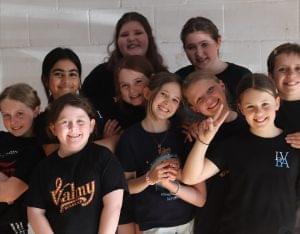
At Valmy Academy, our uniform is one of the small but deliberate ways we build that connection. Whether you’re six or sixteen, wearing the same blacks says, “You belong here. You’re part of this.” It dissolves hierarchy, quiets comparison, and creates equality. It turns a group of individuals into an ensemble — a company.
For many of our students, that sense of belonging is transformative. Especially for those who struggle with confidence, anxiety, or self-image, the uniform becomes a safety net — a reminder that they are part of something stable, supportive, and shared.
And perhaps that’s the quiet magic of it all. The uniform isn’t just fabric; it’s identity. It’s the visual heartbeat of who we are as a community — a collection of individuals learning to move, think, and create together.
When every student walks into the room dressed alike, they’re not losing individuality — they’re gaining unity. They’re learning one of the most important lessons the performing arts can teach: that belonging doesn’t come from standing out — it comes from standing together.
So What Does This Mean?
At Valmy Academy, we keep our uniform simple because simplicity works. The psychology of the performing arts uniform isn’t about control; it’s about creating readiness, equality, and pride.
Every time a student ties their hair neatly, laces their shoes, and steps onto the floor in theatre blacks, they’re rehearsing more than choreography. They’re practising professionalism, focus, and belonging. They’re learning that presentation and preparation aren’t about appearance — they’re about attitude.
And those are lessons that carry far beyond the stage.
Lee Valmy
Founder & Director, Valmy Academy